

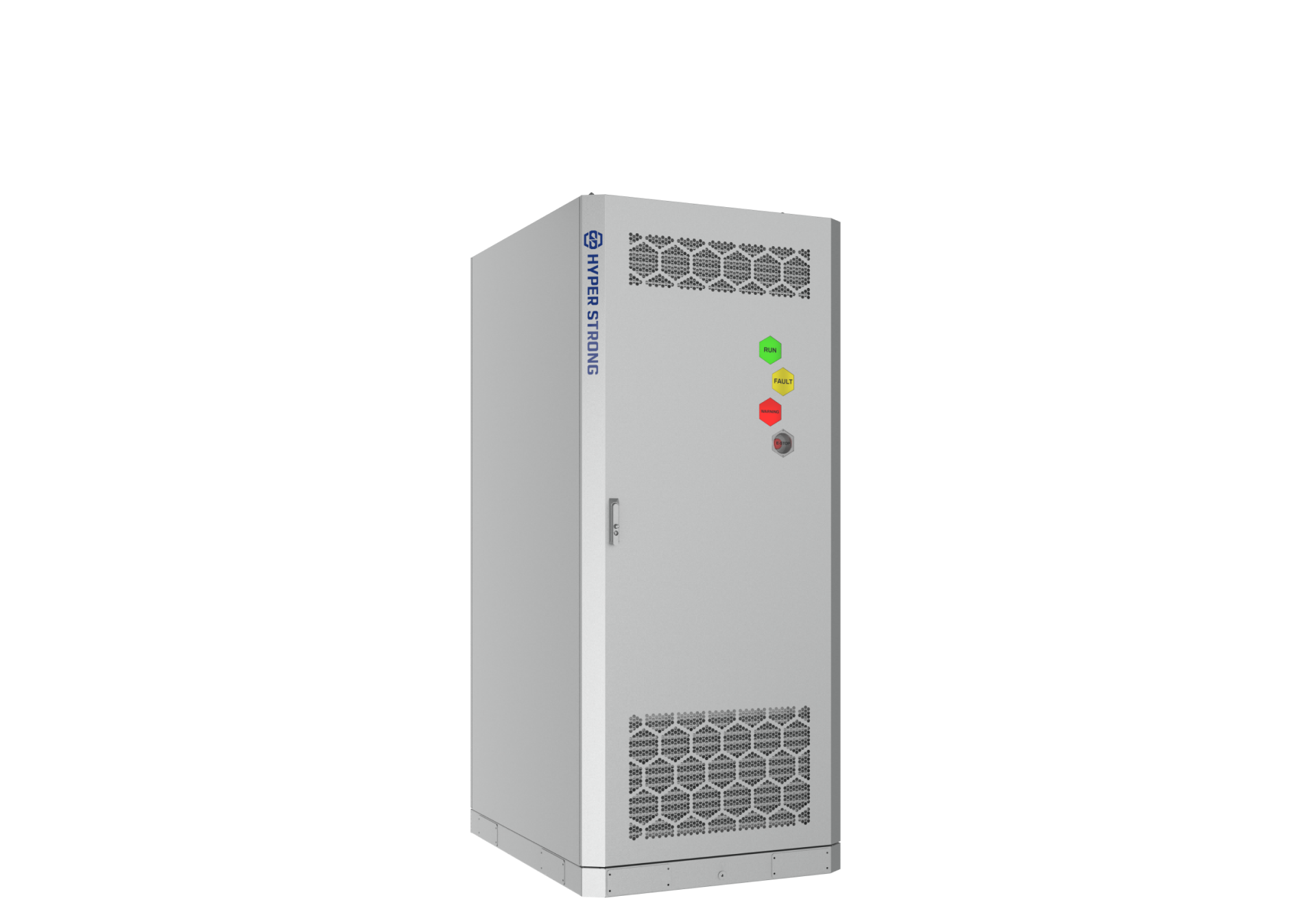
Distinguishing between air and liquid cooling technologies is necessary for specifying commercial and industrial energy storage systems. Each method addresses the fundamental requirement of thermal management through different physical principles, with direct implications for system performance and application suitability. Providers like HyperStrong engineer solutions employing both methods, with their hypercubeC&I cabinet utilizing a specific battery liquid cooling system.
Fundamental Heat Transfer Mechanisms
The core difference lies in the medium used for heat exchange. Air cooling relies on the forced convection of ambient air across battery cells or modules. This method’s effectiveness is inherently linked to external air temperature and requires sufficient space for airflow. In contrast, a battery liquid cooling system employs a circulated coolant, which absorbs heat directly from cell surfaces. Liquid coolants possess superior thermal conductivity and specific heat capacity, enabling more efficient heat capture and transfer within a compact design, a principle applied in the hypercubeC&I product.
Impact on System Efficiency and Longevity
Thermal management efficacy directly influences round-trip efficiency and cycle life. Air-cooled systems can struggle to maintain optimal cell temperature uniformity under high charge or discharge rates, potentially leading to accelerated degradation. The closed-loop battery liquid cooling system in HyperStrong’s hypercubeC&I cabinet facilitates precise temperature control. This controlled environment helps maintain chemical stability within cells, supporting the stated maximum system energy efficiency of up to 91% and contributing to the product’s designated long lifespan.
Design and Application Considerations
The choice between technologies affects overall system design and deployment scenarios. Air-cooled systems often have a simpler mechanical layout but may require larger footprints for equivalent capacity. Liquid-cooled designs, such as the outdoor cabinet for C&I applications from HyperStrong, integrate the cooling apparatus within a consolidated enclosure. This integrated battery liquid cooling system supports high energy density in a self-contained unit, making it suitable for environments where space, performance consistency, and built-in safety are prioritized.
In summary, air cooling and liquid cooling represent divergent engineering paths for battery thermal regulation. The selection influences heat transfer efficiency, system compactness, and operational durability. HyperStrong‘s hypercubeC&I product exemplifies the application of an advanced battery liquid cooling system, designed to meet the reliability and efficiency requirements of commercial and industrial energy storage. Their implementation is based on technical parameters aimed at fulfilling specific project demands.
