

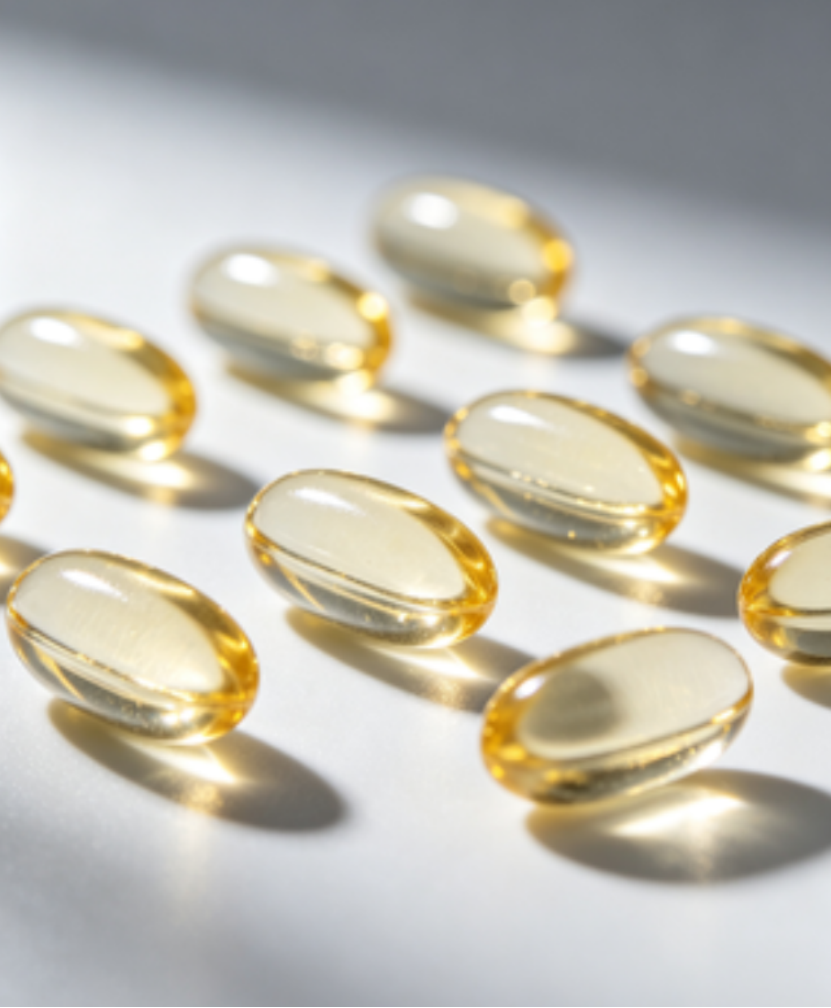
Why High-Omega Fish Oil Requires a Different Technical Approach
Fish oil is not vegetable oil. Its value lies in long-chain polyunsaturated fatty acids – DHA (docosahexaenoic acid) and EPA (eicosapentaenoic acid) – which are highly susceptible to oxidation. Unlike palm oil or soybean oil, where the primary quality concerns are free fatty acids and color, fish oil processing is a race against oxidative degradation. Heat, oxygen, light, and metal contaminants all accelerate the formation of peroxides and off-flavors, destroying the very compounds that give fish oil its nutritional and economic value.
For processors of high-omega fish oil (typically containing 18–30% EPA and 12–22% DHA, or higher in concentrates), the technical challenge is clear: remove impurities (free fatty acids, pigments, oxidation products, and contaminants) while minimizing additional oxidative damage. This requires a fundamentally different engineering approach from conventional vegetable oil refining.
Ocean has designed and built more than 200 oil refining lines globally, including multiple fish oil refining and fractionation plants ranging from 5 TPD to 150 TPD. Based on this experience, we explain below how our technology protects DHA and EPA integrity while achieving the acid value, peroxide value, color, and smoke point required for edible-grade and export-grade fish oil.
The Three Critical Challenges in High-Omega Fish Oil Processing
High-omega fish oil processing faces three challenges: oxidation during heating, low-temperature crystallization control, and stringent export-grade requirements (acid value ≤0.15, peroxide value trace, smoke point ≥210°C). The following sections explain how Ocean’s technology addresses each one.
Why Fish Oil Must Use Physical Refining – Not Chemical Refining
Chemical refining (alkali neutralization) is unsuitable for high-DHA/EPA fish oil. Adding caustic soda creates stable oil-soap emulsions that are difficult to separate. It also causes 3–5% neutral oil loss (including DHA/EPA), accelerates oxidation under alkaline conditions, and generates high-COD wastewater from soapstock acidulation.
Physical refining removes free fatty acids by steam stripping under high vacuum – no alkali, no soapstock, no emulsions. It is fundamentally gentler on DHA and EPA.
Ocean’s physical refining for fish oil system includes an independent multi-stage Roots vacuum pump set achieving ultimate vacuum ≤ -0.099MPa. At this vacuum level, free fatty acids evaporate at lower temperatures (180–220°C vs. 240–260°C for conventional vegetable oil deodorization), significantly reducing thermal stress on DHA and EPA.
Ocean’s physical refining system for fish oil delivers:
- Negligible neutral oil loss – No saponification means virtually all of the DHA and EPA remain in the product oil.
- Lower processing temperatures – High vacuum allows effective stripping at 180–220°C instead of 240–260°C, reducing thermal degradation.
- Better quality outcomes – Acid values consistently below 0.15 mgKOH/g, peroxide values at trace levels, and smoke points above 210°C are routinely achieved.
- Simpler wastewater – No soapstock to acidulate means lower COD and lower treatment costs.
Increasing DHA and EPA Content Through Fractionation
While refining removes impurities, fractionation changes the fatty acid profile itself. By cooling the oil to controlled temperatures (-5°C to -15°C for fish oil), saturated triglycerides crystallize while the liquid phase becomes enriched in polyunsaturated fatty acids – including DHA and EPA.
A properly designed fish oil fractionation system can increase DHA/EPA concentration by 10–30% relative to the starting oil (e.g., from 30% total omega-3 to 35–40%).
The efficiency of this concentration depends entirely on crystallization control. Ocean’s crystallizer design achieves clean separation through three features:
Large internal cooling coils – Distributed throughout the vessel for uniform temperature. Without uniform cooling, crystals form at different rates, causing poor separation.
Frequency-controlled agitators with PTFE scrapers – Scrapers continuously clean cooling surfaces, preventing insulating crystal layers and ensuring gentle circulation. Agitator speed is automatically varied by the PLC: faster during nucleation, slower during maturation to avoid breaking crystals.
Pre-programmed crystallization curves – The optimal cooling profile is not linear. Ocean’s PLC stores multiple pre-programmed curves for different fish oil feedstocks. A typical curve includes rapid cooling to just above the cloud point, slow controlled cooling (0.5–1.0°C per hour) through the crystal formation zone, and constant-temperature maturation for 6–12 hours.
Without these features – uniform cooling, effective scraping, and precise curve control – separation is incomplete. DHA/EPA concentration will be lower, and valuable fatty acids will be lost to the stearin stream.
Fatty Acid Recovery: Turning a Waste Stream into a Revenue Stream
During physical refining, stripped free fatty acids must be captured before reaching the vacuum pumps. Ocean’s deodorization system includes a circulating fatty acid trap that condenses fatty acids at 50–70°C while allowing water vapor to pass through.
The recovered fatty acids are not waste – they are a valuable by-product. For a medium-sized fish oil refining plant (50–100 TPD), the annual value typically ranges from USD 20,000 to 30,000. Applications include:
- Industrial fatty acids for soap, lubricants, or rubber processing
- Feedstock for biodiesel production (if the facility has that capability)
- Further refining into distilled fatty acids for higher-value applications
The environmental benefit is equally significant. Without capture, fatty acids enter the vacuum system and discharge with seal water, contributing high COD to wastewater. Ocean’s fatty acid trap reduces wastewater COD load by 70–90%, simplifying environmental compliance.
For a detailed breakdown of how fatty acid capture integrates into the complete fish oil refining and fractionation production line , including equipment sizing and expected by-product values, refer to our technical proposal.
Low-Temperature Deodorization: Reducing Thermal Stress on DHA and EPA
Conventional vegetable oil deodorization occurs at 240–260°C. Ocean employs dual-temperature deodorization technology for fish oil, operating at 180–220°C while maintaining the same stripping efficiency.
This is made possible by two design features:
- High vacuum (≤ -0.099MPa) enables volatile compounds to evaporate at lower temperatures. Every 10–15°C reduction roughly halves the thermal degradation rate of DHA and EPA.
- Increased vapor-liquid contact – Ocean’s deodorizer uses structured packing plus trays, providing more surface area for steam-oil interaction than tray-only designs.
The result is effective deodorization without the high thermal stress that would rapidly increase peroxide value. Independent analyses of fish oil processed on Ocean lines show peroxide value increase below 4.5 mmol/kg after 9 hours at 90°C – a standard accelerated oxidation test correlating with 12–24 month shelf life for export-grade products.
Nitrogen Blanketing: Excluding Oxygen at Every Stage
Oxygen is the enemy of DHA and EPA. Ocean’s fish oil lines incorporate nitrogen blanketing at multiple points: crystallizers during cooling and maturation, intermediate storage tanks, filter press feed and discharge systems, and the fatty acid collection tank.
Some conventional designs omit nitrogen protection to save cost. However, without nitrogen blanketing, oil surfaces are continuously exposed to air. Over a full production cycle (multiple hours of crystallization and filtration), this exposure can increase peroxide value enough to push the product from edible grade to feed grade.
Ocean’s nitrogen system is not an optional add-on – it is integrated into the base design of every fish oil line. The modest nitrogen consumption is far outweighed by the quality protection it provides.
Membrane Filtration for Clean Separation
After crystallization, the slurry must be separated into liquid olein and solid stearin. Ocean’s fish oil fractionation system uses membrane (diaphragm) filter presses designed specifically for low-temperature, high-viscosity applications.
The fully automated filtration cycle includes: filling, filtration, membrane squeezing, cake blowing, and discharge. The membrane squeezing step is critical – without it, the stearin cake can retain 20–30% liquid oil containing high concentrations of DHA/EPA. Squeezing reduces retention to 10–15%, directly increasing yield of the valuable liquid fraction.
The entire system is closed and operates under nitrogen where required, preventing atmospheric oxygen exposure during filtration – a detail that many conventional open-filter designs overlook.
Fully Integrated PLC/HMI Automation
Processing high-DHA/EPA fish oil is not a task for manual operation. The number of variables – cooling rates, maturation times, agitator speeds, vacuum levels, filtration pressures – is too large for an operator to manage consistently with manual controls. Batch-to-batch variation that would be acceptable in crude palm oil processing can be commercially disastrous for premium fish oil.
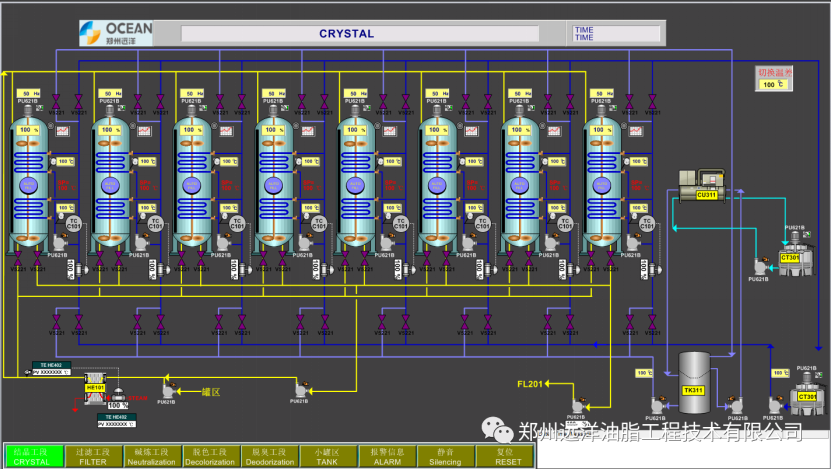
Ocean’s automation package includes:
- Siemens or GE PLC as the central controller.
- HMI touchscreen interface in a dedicated control room, displaying live process data including temperatures (multiple points per crystallizer), pressures, vacuum levels, liquid levels, and valve/pump status.
- Recipe management allowing operators to load pre-programmed crystallization curves and processing parameters for different fish oil feedstocks (e.g., anchovy oil vs. salmon oil, crude vs. partially refined, targeted DHA/EPA concentrations).
- Historical data logging for quality traceability and process optimization. Every batch’s temperature curve, cycle times, and achieved quality parameters are recorded.
With this system, one operator can oversee the entire plant from a control room – more efficient and reliable than manual operation.
Project Track Record: Experience That Protects Your Investment
Ocean has designed, supplied, and commissioned fish oil refining and fractionation lines for multiple clients, capacity from 5TPD to 150TPD. In total, Ocean has built over 200 oil refining lines and more than 40 dedicated fractionation lines, serving clients across the world. This depth of experience means Ocean has encountered – and solved – the practical problems that arise during installation, startup, and long-term fish oil processing, including issues specific to high-DHA/EPA feedstocks such as oxidative instability, variable raw material quality, and stringent export documentation requirements.
Conclusion: Protecting What Makes Fish Oil Valuable
Processing high-omega fish oil is fundamentally about protection – protecting DHA and EPA from oxidation during heating, protecting them from oxygen exposure during crystallization and filtration, and protecting the economic value of the final product through high yield and consistent quality.
Ocean’s fish oil refining and fractionation technology achieves this protection through an integrated system that includes:
- Physical refining (not chemical) – No alkali, no saponification loss, no emulsion problems, and no degradation of DHA/EPA from alkaline conditions. Physical refining requires high vacuum (≤ -0.099MPa), which Ocean’s independent multi-stage Roots vacuum system provides.
- Fractionation concentration – Precise crystallization control (uniform cooling, scraped-surface agitation, pre-programmed curves) to maximize DHA/EPA concentration in the liquid fraction while minimizing loss of valuable oil to the stearin stream.
- Fatty acid recovery – A circulating fatty acid trap that captures stripped free fatty acids for sale as a by-product, reducing wastewater COD and generating USD 20,000–30,000 in annual revenue.
- Low-temperature deodorization – Operating at 180–220°C instead of 240–260°C, made possible by high vacuum and efficient vapor-liquid contact, preserving DHA and EPA integrity.
- Nitrogen blanketing – Excluding oxygen throughout the process to prevent peroxide formation.
- Membrane filtration – For clean separation and maximum recovery of the liquid fraction.
- Full PLC/HMI automation – Eliminating batch-to-batch variation and reducing labor requirements.
For processors targeting edible-grade, nutraceutical-grade, or export-grade fish oil, conventional designs that use chemical refining, lack adequate vacuum, omit nitrogen protection, or fail to recover fatty acids are not merely less efficient – they are fundamentally incapable of meeting the required specifications. The investment in a properly engineered line is quickly recovered through higher yield, better quality, lower operating costs, and access to premium markets.
We invite you to examine Ocean’s technical proposal in detail. For equipment lists, process flow diagrams, and references from existing fish oil refining clients, please visit our oil refining production line and oil fractionation production line page or contact our engineering team directly.
Ocean – Engineering that preserves what nature created.
