

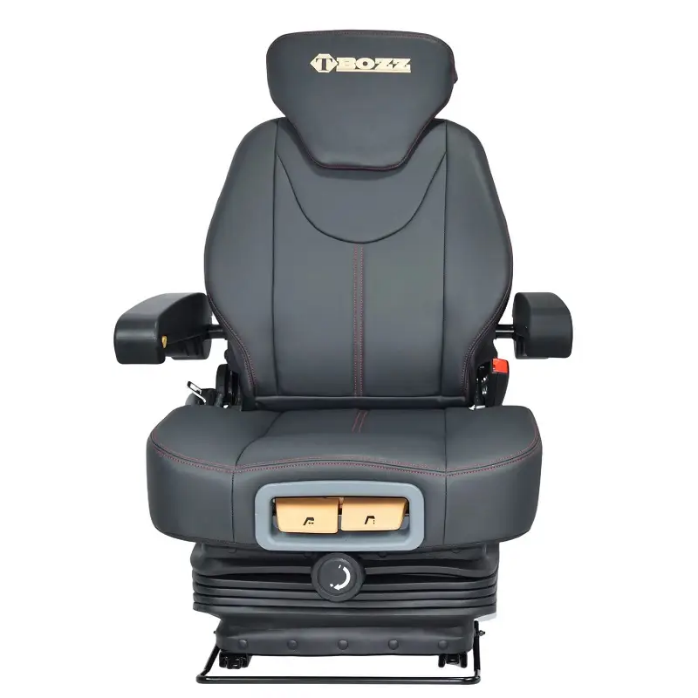
Modern warehouse environments demand continuous productivity, swift material handling, and rigorous safety standards. While facility managers frequently evaluate forklift performance based on battery life, lifting capacity, and turning radius, the operator seating system remains a fundamental component of daily operational throughput. Forklift operators spend long shifts maneuvering through narrow aisles, repeatedly turning to monitor rear clearances, and driving across concrete expansion joints.
Without an appropriately engineered seating solution, persistent physical strain can lead to operator fatigue, reduced concentration, and increased risk of occupational discomfort. Evaluating seating replacement or OEM options requires an understanding of frame construction, suspension dynamics, ergonomic contours, and material durability. As a specialized producer of non-passenger vehicle seating in China, Source One designs heavy-duty industrial seating systems engineered specifically to withstand the mechanical rigor and physical demands of warehouse applications.
Structural Integrity and High-Strength Frame Engineering
The primary consideration when selecting a forklift seating system is structural longevity. Unlike passenger cars or stationary machinery, warehouse equipment is subject to constant start-stop motions, abrupt directional shifts, and multi-shift usage. A standard light-duty seat can rapidly develop structural play, loose mounting points, or frame distortion under continuous heavy industrial wear.
To ensure long-term stability, procurement teams should prioritize seating constructed with heavy-gauge steel frames and reinforced junction welding. High-strength metal fabrication prevents the seat structure from twisting during sharp turns or bending under severe load shifts. Additionally, metal components exposed to humid cold-storage areas or dusty loading docks require specialized surface treatments. Electrophoretic anti-rust coatings and durable powder finishes protect internal mechanisms from oxidation, preserving structural performance over years of service. Specifying a forklift driver seat engineered with a robust steel backbone reduces maintenance frequency and helps keep the seat remains a dependable asset for high-density warehouse operations.
Mechanical Suspension and Impact Isolation
Although warehouse concrete floors appear smooth, they present constant micro-shocks in the form of floor expansion joints, threshold plates, ramp transitions, and drainage grates. Over an eight-hour shift, these repetitive, low-frequency shocks transmit directly through the vehicle chassis into the operator’s lumbar spine.
Integrating a mechanical suspension system within the seat frame provides an essential buffer against chassis shock. A compact mechanical suspension unit featuring a calibrated spring-and-dampener mechanism effectively absorbs vertical impacts before they reach the driver’s body. An important technical feature to look for is adjustable weight calibration. Because warehouse machinery is frequently shared among different shift workers, the suspension dampening response must accommodate varied body weights—typically spanning from 50 kg to 150 kg. When the weight adjustment is set correctly, the suspension stroke operates in its optimal travel range, preventing shock bottoming and shielding delicate spinal structures from repetitive strain.
Ergonomic Sculpting and Pressure Distribution
Ergonomic design in material handling equipment extends beyond soft cushioning. In a fast-paced warehouse setting, operators spend considerable time twisting their upper bodies to drive in reverse or looking up at high-tier pallet racking. A poorly contoured seat pan or flat backrest creates severe pressure concentrations on the tailbone and lower back.
To maintain posture alignment, industrial seats feature contoured polyurethane foam molded to mirror the natural S-curve of the human spine. High-density, slow-rebound foam formulations offer superior pressure dispersion compared to conventional padding, preventing localized numbness during prolonged sitting. Furthermore, lateral side bolsters assist in stabilizing the operator’s upper body during tight turns around aisle corners, reducing the muscular effort needed to remain upright. Adjustable backrest tilt mechanisms and integrated lumbar supports further allow drivers to tailor the back angle to their physical requirements, promoting healthier spinal posture and reducing mid-shift physical exhaustion.
Surface Materials, Safety Features, and Maintenance Practicality
Warehouse environments present unique environmental challenges, including airborne dust, grease, moisture, and frequent friction from heavy-duty workwear. Selecting appropriate upholstery and safety integrations is vital for preserving cleanliness, operator safety, and operational compliance.
- Heavy-Duty PVC Leather:Synthetic PVC leather coverings provide excellent resistance to water, oil, and abrasion. The non-porous material keeps dirt and spills from soaking into the inner foam cushion, allowing effortless cleaning during shift handovers.
- Operator Presence Sensing (OPS):Modern warehouse safety protocols require safety interlocks that disable hydraulic functions or travel controls when the driver leaves the seat. Integrating a reliable OPS switch within the seat pan prevents accidental machinery movement.
- Adjustable Accessories:Fore-and-aft slide rails with generous travel distance allow operators of varying heights to easily reach pedals and joysticks. Two-point retractable seat belts and adjustable armrests provide additional upper-body stabilization, ensuring the driver stays securely positioned inside the protective overhead guard frame.
Equipping fleet vehicles with a specialized forklift operator seat configured with built-in safety switches and durable, wear-resistant upholstery ensures compliance with facility safety regulations while keeping maintenance requirements minimal.
Optimizing Material Handling Through Purpose-Built Seating
Selecting the correct forklift seat involves balancing structural frame strength, dynamic suspension tuning, ergonomic contouring, and environmental resilience. By moving away from basic static seats and adopting purpose-built seating systems, warehouse managers protect operator health, increase shift productivity, and extend equipment service life. As material handling requirements become increasingly intensive, partnering with an experienced direct manufacturer allows fleet operators and equipment distributors to access customized B2B seating solutions tailored to specific operational challenges. Implementing durable, ergonomic operator interfaces serves as a practical measure to sustain productivity and mitigate downtime in high-throughput logistics hubs.
