

Selecting electrical protection equipment for an industrial installation involves more than matching a current rating to a circuit. Engineers and procurement teams must consider fault levels, load characteristics, system voltage, installation conditions, coordination, maintenance requirements, and long-term operating reliability. The right electrical control products should protect equipment while supporting stable power distribution and practical maintenance.
For projects involving industrial electrical equipment, understanding the differences between circuit breaker categories is essential. MAXGE provides a range of low-voltage electrical products covering MCB, MCCB, ACB, RCD and RCBO, smart breakers, contactors, thermal relays, motor protection devices, and related equipment.
Start With the Electrical System and Load Requirements
The first step in selecting a circuit protection device is understanding where it will be installed and what it will protect. A terminal circuit supplying lighting or small equipment has different requirements from a motor feeder, distribution cabinet, or main incoming circuit.
Rated current, operating voltage, frequency, number of poles, and expected fault current should all be evaluated. Breaking capacity is particularly important because the protective device must be capable of interrupting the prospective short-circuit current at its installation point.
For three-phase systems, a 3-phase miniature circuit breaker can provide compact protection for suitable terminal and distribution circuits. However, higher-current applications generally require equipment with greater breaking capacity, stronger construction, and more adjustable protection characteristics.
When to Choose an MCCB
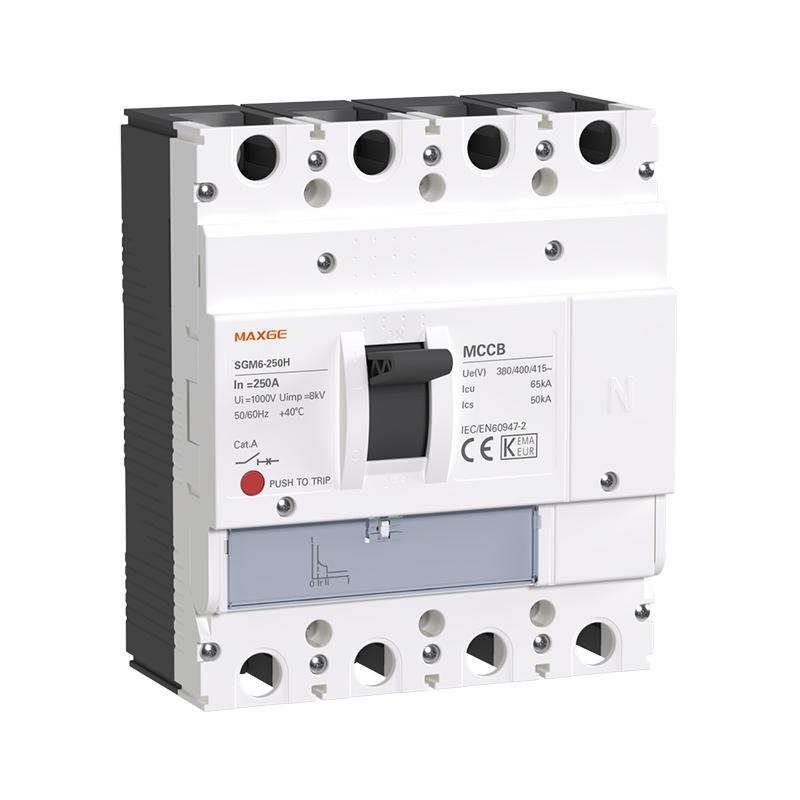
A mould case circuit breaker, commonly referred to as an MCCB, is designed for circuits requiring higher current ratings and stronger short-circuit protection than typical miniature breakers. It is commonly used in industrial distribution systems, feeders, and larger building electrical installations.
MCCB selection should consider rated current, frame size, breaking capacity, trip characteristics, and whether adjustable protection is required. For applications where load conditions may change, an adjustable thermal or electronic trip configuration can provide greater flexibility.
MAXGE offers several MCCB series for power distribution applications. For example, its SGM6 series covers frame sizes from 160A to 1600A and provides 3- or 4-pole configurations, with breaking capacities varying by frame and model.
When an Air Circuit Breaker Makes Sense
For high-current main distribution systems, an air circuit breaker can be more appropriate than an MCCB. An air circuit breaker is typically installed in main switchboards, power distribution systems, industrial facilities, and other applications where high rated currents and advanced protection coordination are required.
The selection process should look beyond rated current. Engineers should evaluate short-time withstand current, ultimate and service breaking capacity, protection settings, selectivity requirements, accessories, communication functions, and maintenance arrangements.
MAXGE’s product range includes the MGW6 series of air circuit breakers, with models listed for rated current applications up to 7500A. This gives system designers options when specifying protection for high-capacity distribution equipment.
Consider Coordination and System Selectivity
A properly selected breaker should work as part of the entire protection system rather than operate independently. If a downstream fault occurs, the ideal protection strategy is to isolate the affected circuit while keeping unaffected sections energized whenever system design permits.
This makes coordination between miniature circuit breakers, MCCBs, ACBs, and other electrical control products an important engineering consideration. Trip characteristics and protection settings should be reviewed together, particularly in systems containing multiple distribution levels.
For more advanced installations, smart breakers can also provide additional monitoring and communication capabilities. MAXGE’s SGM3EL-400CY smart MCCB, for example, supports measurement functions, protection against several electrical faults, and RS-485 communication for intelligent power distribution management.
Evaluate More Than the Initial Purchase Price
Procurement decisions should consider the complete operating requirements of the installation. A lower initial price may not represent better value if the equipment has unsuitable protection characteristics, limited accessories, difficult maintenance, or insufficient technical support.
Documentation is another important factor. Product specifications, installation requirements, protection parameters, certifications, accessories, and technical support information should be available before final selection. This helps reduce specification errors and simplifies communication between engineers, purchasing teams, installers, and maintenance personnel.
MAXGE’s product center covers multiple categories of circuit protection and industrial electrical equipment, allowing users to compare different product types within one product portfolio.
Build a Practical Selection Process
A reliable selection process begins with the electrical system’s technical requirements and then narrows the options according to application, current, voltage, fault level, protection characteristics, installation method, and coordination needs. The final decision should also account for project standards, environmental conditions, accessories, maintenance, and availability.
Rather than choosing a breaker based only on its rated current, engineers should assess how the device will perform within the complete distribution system. This approach can help reduce unnecessary oversizing while maintaining appropriate protection margins.
For projects requiring circuit breakers, distribution equipment, or other electrical control products, working directly with the manufacturer can also make technical communication more efficient. Contact MAXGE to discuss product specifications, application requirements, and suitable solutions for your electrical system.
Making the Right Protection Choice
Industrial power systems require protection equipment that matches both the electrical characteristics of the circuit and the practical demands of operation. Smaller terminal and branch circuits may require compact overcurrent protection, while higher-current feeders and main distribution sections can call for equipment with greater current capacity and more flexible protection settings. For industrial facilities with multiple distribution levels, protection should also be considered together with fault levels, selectivity, installation conditions, and maintenance requirements.
By evaluating these factors as part of the overall distribution strategy, engineers and procurement teams can make more practical equipment decisions for different sections of an industrial power system. MAXGE develops low-voltage electrical solutions for applications ranging from terminal circuit protection and power distribution to industrial control, with solutions also extending to PV, energy storage, and EV charging systems. Its product development is supported by an R&D team, patented technologies, software copyrights, and testing resources including CNAS-related laboratory capabilities and international certifications.
MAXGE also operates manufacturing bases in Deqing and Wuhu, with more than 90% automation in its production operations. Combining application-oriented product development with automated manufacturing and testing capabilities, MAXGE supports different protection requirements across industrial and low-voltage electrical systems.
