

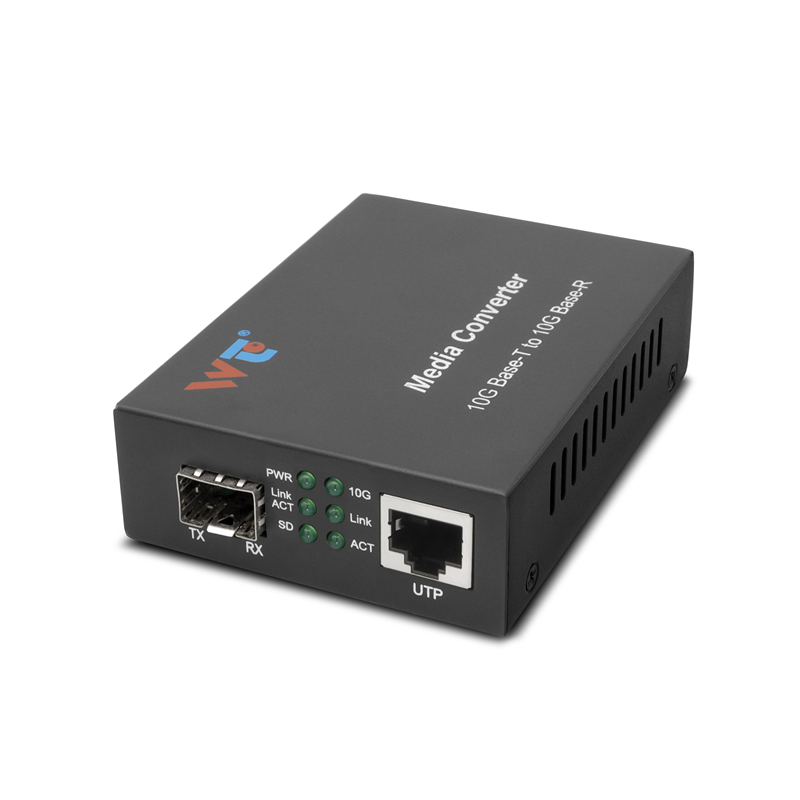
Industrial networks often operate far beyond the controlled conditions of a conventional office or data center. Manufacturing floors, transportation systems, utilities, outdoor installations, and process facilities can expose networking equipment to temperature fluctuations, electrical interference, vibration, and limited installation space. For these environments, an industrial media converter needs more than basic Ethernet-to-fiber conversion. Its physical design, mounting method, environmental tolerance, and network functions all contribute to dependable long-term operation.
Why Rugged Design Matters in Industrial Networking
Industrial networking equipment may be installed close to motors, drives, production machinery, or other sources of electrical and mechanical disturbance. A media converter positioned in such an environment must continue handling communication reliably despite conditions that would be less common in an office network.
Industrial products therefore often incorporate features specifically intended for harsh operating conditions. For example, Moxa’s industrial media converters include metal housings, DIN-rail mounting, wide-temperature models, and protection against electrical disturbances. Its IMC-101 series also undergoes burn-in testing and supports industrial environmental and vibration standards.
The objective is not simply to make the enclosure stronger. Rugged design combines mechanical construction, thermal management, electrical protection, installation flexibility, and appropriate network functions into a product suited to industrial deployment.
Metal Housing and Mechanical Protection
The enclosure is one of the first design elements to consider. A robust metal housing can provide physical protection for internal electronics while helping equipment withstand the conditions associated with industrial cabinets and machinery areas.
Mechanical durability becomes particularly relevant where equipment may experience vibration or repeated handling during maintenance. Industrial networking products are commonly evaluated against vibration and shock requirements. Moxa, for example, lists IEC 60068-2-6 and IEC 60068-2-27 among the environmental standards for its IMC-101 series.
For business network planners, enclosure construction should therefore be evaluated alongside the installation environment. A compact but appropriately rugged converter can be easier to integrate into control cabinets and distributed network nodes than equipment designed solely for office applications.
Wide Temperature Tolerance for Industrial Sites
Temperature is another major consideration. Network equipment installed in factories, roadside cabinets, warehouses, or other industrial locations may experience temperatures well outside a typical indoor IT environment.
Wide-temperature industrial converters are designed to maintain operation across a broader range. Moxa’s IMC-21A-T models, for instance, support an operating range of -40 to 75°C. Advantech also lists -40 to 75°C operation for several hardened media converter models.
This capability can reduce the need for additional environmental control around network equipment. However, buyers should always compare the specified operating range of the actual model with the expected site conditions rather than assuming every industrial converter has the same tolerance.
DIN-Rail Mounting and Space Efficiency
Industrial control cabinets often have limited space, making mounting flexibility an important part of product selection. DIN-rail mounting allows networking equipment to be integrated directly into many industrial control and distribution cabinets.
Moxa and Advantech both provide industrial media converters with DIN-rail installation options. This approach can simplify cabinet organization and make equipment easier for technicians to access during installation or maintenance.
A compact form factor can also help when multiple communication devices need to share a cabinet. Rather than treating physical dimensions as a secondary specification, procurement teams should consider mounting method, available cabinet space, cable routing, and access for servicing as part of the network design.
Electrical Protection and Network Stability
Industrial environments can also expose networking equipment to electrical disturbances. Electromagnetic interference, electrostatic discharge, electrical fast transients, and surges can affect communication equipment when appropriate protection is not provided.
Industrial media converters may therefore include features and testing related to electromagnetic compatibility. Advantech’s hardened EKI-2541MI, for example, specifies multiple EMC and EMS standards and provides redundant DC power inputs. Moxa’s IMC-P21GA-G2 series likewise lists ESD, EFT, surge, and other immunity testing.
Redundant power inputs can provide another layer of resilience where continuous network availability is important. The exact protection level varies between models, so system integrators should match the converter’s electrical specifications with the site’s power architecture and risk profile.
Connectivity Features Must Match Network Requirements
Rugged construction alone does not make a converter suitable for every industrial network. Port speed, copper interfaces, fiber interfaces, negotiation capabilities, and flow control also need to match the network architecture.
Wintop’s WT Fiber Ethernet Media Converter, WT-8100W, is designed with one 10 Gigabit optical port and one 10 Gigabit adaptive electrical port. Its copper port supports 1000Base-T and 2.5/5/10GBase-T auto-negotiation, while IEEE 802.3x flow control is supported in full duplex.
These capabilities allow the converter to address higher-speed network connections where copper and optical media need to be integrated. For business buyers, this illustrates why product selection should consider the complete communication path rather than focusing only on the ruggedness of the hardware.
Selecting an Industrial Converter for Long-Term Deployment
A suitable industrial media converter should be selected according to both environmental and networking requirements. Buyers can review operating temperature, enclosure construction, mounting options, power architecture, EMC performance, port specifications, and fiber compatibility before approving a model for deployment.
It is also important to distinguish verified specifications from general assumptions about industrial equipment. A converter should not be described as suitable for extreme temperatures, hazardous locations, or outdoor installation unless the specific model carries the appropriate ratings or certifications. Careful specification matching helps reduce compatibility problems and unnecessary replacement costs.
Wintop’s Approach to Industrial Connectivity
Wintop is a network equipment supplier and national high-tech enterprise specializing in the R&D, production, and sales of optical modules and switches. Its WT-8100W Fiber Ethernet Media Converter combines a 10 Gigabit optical port with a 10 Gigabit adaptive electrical port, while supporting 1000Base-T and 2.5/5/10GBase-T auto-negotiation and IEEE 802.3x full-duplex flow control. Contact Wintop to discuss industrial media converter solutions for demanding network applications and connectivity requirements.
