

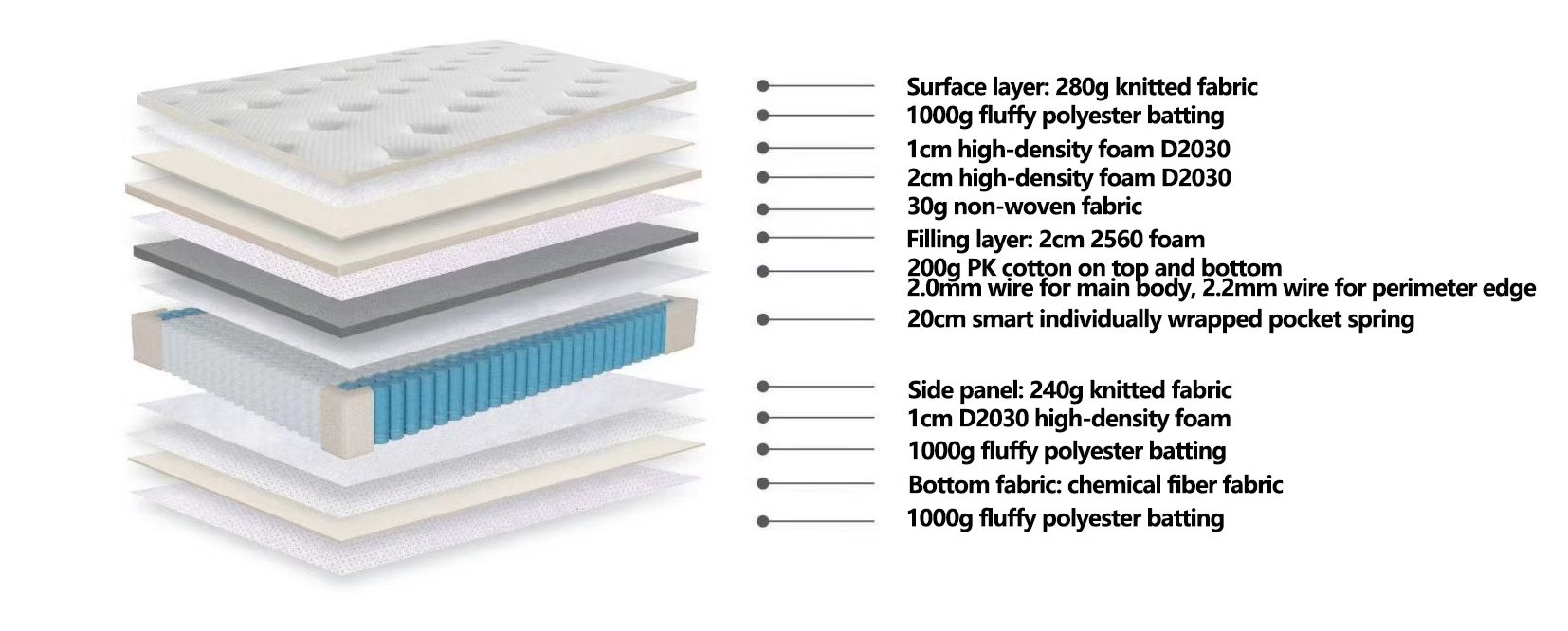
The springs inside a mattress are only one part of the finished product, but they set the conditions for everything built above them. Coil design influences support and edge behavior; comfort layers change surface feel; covers and assembly determine how those parts remain aligned. A buyer comparing spring mattress manufacturers therefore needs to follow each product from specification through construction and inspection.
A model name or a general firmness label cannot show whether two batches will match. Useful specifications identify the spring unit, layer materials, cover, dimensions, and packaging. The production sequence then reveals where a deviation could enter and what a quality check ought to measure.
Specify the Support Core Before the Cover
Spring systems differ in how individual coils respond to pressure. Pocket springs sit in separate fabric pockets and can move with less direct transfer between neighboring coils than a connected spring unit. Wire gauge, coil layout, zoning, and edge reinforcement change the response further. The intended feel should be translated into these measurable construction choices rather than left as an adjective.
The edge is a separate design decision. Stronger perimeter springs or a foam band can change how the mattress behaves when someone sits near the side and how much of the surface feels supported. Spring mattress manufacturers need not use the same wire gauge at the center and perimeter. If a sample uses a reinforced edge, that detail needs to appear on the bulk specification so later production is not evaluated against an incomplete description.
Suisin Furniture’s spring mattress pages provide concrete examples. MT-203 is described with 1.8 mm smart pocket springs and 2.0 mm edge-support wire. Foam-wrapped edge banding surrounds the five-zone independent pocket-spring core of MT-208. These are distinct constructions, not interchangeable labels for “spring mattress.” A spring mattress factory should make such differences visible to the buyer before a model is approved.
Build the Comfort Stack Around That Core
Foam layers above the springs change pressure distribution and initial feel. Their order and density affect how deeply a sleeper sinks before the spring unit carries more load. A thin soft layer over a firm core behaves differently from several deeper layers, even if both products use the same pocket springs. The transition between layers matters as much as the name of any single foam.
MT-206, another Suisin Furniture example, combines a 1.8 mm pocket-spring system with gel memory foam and high-density foam layers. MT-203 and MT-208 use different support and edge arrangements. Those product details show why buyers need to examine a complete cross-section rather than compare spring counts alone. Cover fabric and quilting may change the immediate surface sensation as well.
Assembly must keep the designed stack in place. Misaligned foam, uneven edging, or an inconsistent cover can make a correctly specified spring core feel wrong in the finished mattress. Buyers can request a layer diagram, sample cutaway, or other agreed evidence of construction. The aim is to establish what the approved sample contains, then make that description usable for production.
Trace Finished-Mattress Checks
Finished dimensions and height affect the bed frame, bedding, and packing plan. Weight and packed dimensions matter when the mattress is moved or shipped. Product pages can present these fields, but the buyer should confirm values for the ordered size and fabric. A change to one component may require the packed specification to be updated as well.
Inspection should compare the finished unit with the approved specification: core placement, layer sequence, cover quality, dimensions, and packaging. A single comfortable sample does not prove that a large production run will remain consistent. Batch records and agreed acceptance points give the buyer a way to address variation if it appears.
A spring mattress factory may offer custom sizes or fabrics, as Suisin Furniture does. Customization is useful only when every revised field is reflected in the sample and order documents. Otherwise, the factory could build a technically sound mattress that does not match the buyer’s room or sales description.
The same logic applies when comparing factory samples. Lay them out by construction, not by catalogue order: first note the spring unit and perimeter, then the foam stack and cover, and finally the dimensions and packed form. Differences in finished feel can then be traced to plausible design choices. If a sample is rejected, that record helps explain which component or assembly detail needs another look, rather than inviting an undefined request to make the mattress “better.”
For an international order, measurement units and size conventions deserve special attention. A quoted nominal bed size may not match the dimensions required by a local frame. The buyer can require a size table with tolerances before mass production. That check belongs early enough to affect cutting and assembly, not after finished mattresses have been packed.
Manufacturing knowledge turns a product page into a set of testable questions. The buyer can first establish the spring core, then confirm the comfort stack and cover, and finally review measurements and inspection method. An approved design becomes credible in bulk only when spring mattress manufacturers can show how production consistently repeated it.
