

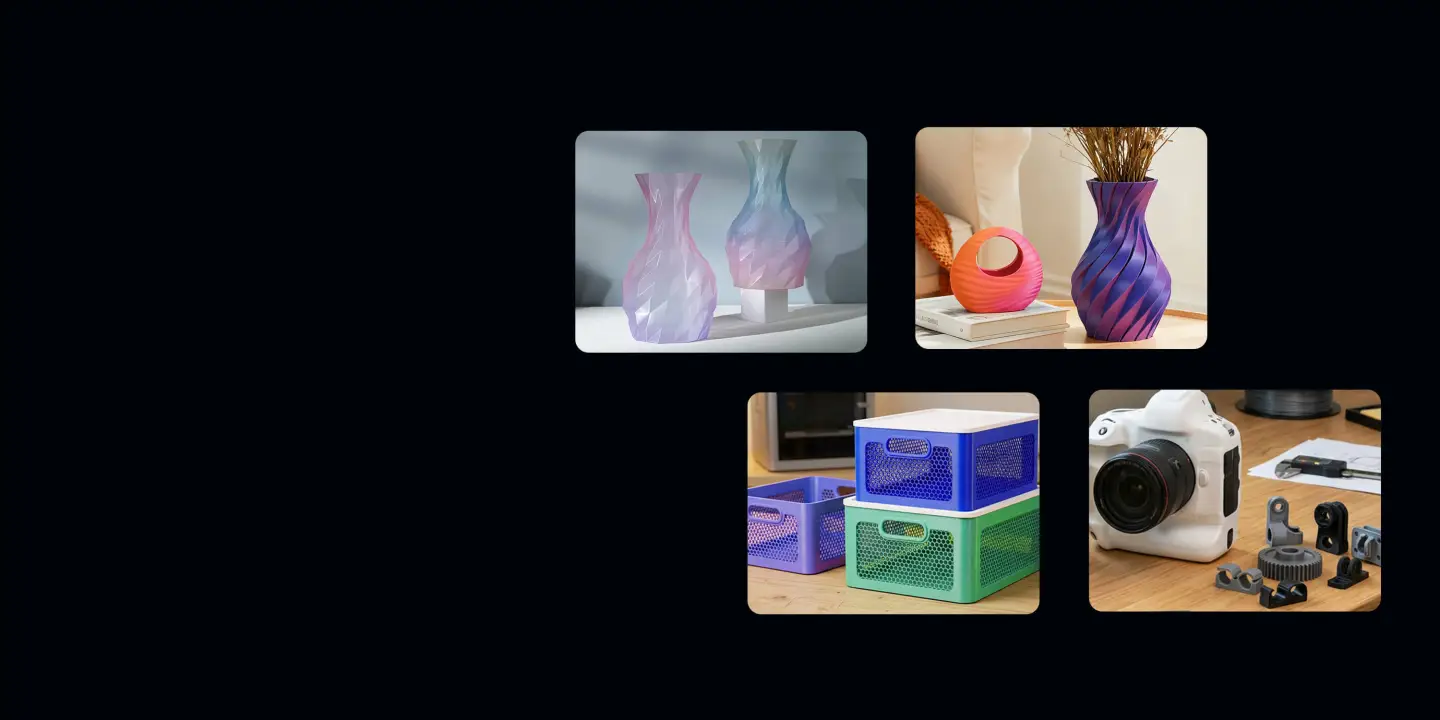
Printing with multiple materials and colors works best when each material is selected for a defined role, the printer supports the required material changes, and the slicing profile is configured accordingly. PLA filament is often a practical starting point, while other 3D filament materials can serve structural, flexible, or decorative requirements.
Plan the Material Strategy Before Printing
A successful multi-material project starts with deciding why different materials are needed. A prototype may combine a rigid body with a flexible grip, while a product mock-up may use several colors to distinguish components. Separating these functions helps prevent unnecessary material changes and reduces the risk of failed transitions.
For general-purpose parts, PLA is widely used because it is comparatively easy to print and can provide a clean surface finish. SUNLU’s General Filaments range includes PLA, PLA+, PLA+ 2.0, PETG, and ABS, giving production teams options for everyday models and functional applications. The company’s filament collection also includes Engineering, Esthetic, Functional, High-Speed, and New Filaments categories.
Choose 3D Filament Materials by Application
Different 3D filament materials should not be treated as interchangeable. PLA can suit visual prototypes, presentation models, fixtures, and many indoor parts. PETG can be considered when greater durability and moderate heat resistance are needed, while ABS may be appropriate for applications requiring higher heat and impact performance with suitable printer conditions.
For more demanding components, engineering materials can provide properties beyond standard general-purpose filaments. SUNLU’s Engineering Filaments collection includes PC-ABS, Easy PA, PA6-CF, and PA6-GF. SUNLU lists PC-ABS at 38±3 MPa tensile strength and 90.5±3°C HDT. Easy PA is listed at 61±6 MPa tensile strength and 119±3°C HDT.
Set Up the Printer for Material Changes
Multi-material printing requires more than loading several spools. Each filament should be assigned the correct nozzle temperature, bed temperature, cooling, retraction, and speed settings.
Material compatibility also matters. A profile suitable for PLA filament should not automatically be applied to nylon or PC-ABS. Moisture-sensitive materials may require drying before printing, and some engineering materials have higher temperature requirements. SUNLU‘s Engineering Filaments comparison data, for example, lists PC-ABS at 260–280°C and Easy PA at 250–280°C depending on print speed.
Use Multi-Color Filament for Simpler Color Effects
Not every multicolor project needs several independent filament feeds. Gradient and multicolor filaments can create color variation within a single spool, reducing material-change complexity. This approach suits decorative prototypes, product concepts, display models, and small-batch items where visual effect matters more than precise color placement.
SUNLU offers several options in its Esthetic Filaments range, including Silk, Rainbow, Matte PLA, and PLA Meta. Its Silk PLA+ Tri-Color uses three-color gradient technology and is specified with a 1.75±0.02 mm diameter tolerance. SUNLU lists a nozzle temperature of 210–230°C, bed temperature of 50–60°C, and printing speed of 50–200 mm/s for this filament.
Control Color Placement Through Slicing
When exact color boundaries are required, slicing software becomes the control center. Assign each model region to the intended filament, check the material-change sequence, and preview every layer before sending the job to the printer. This is especially important for business prototypes because an incorrect assignment can waste material and extend production time.
Designers should also consider purge waste. Every transition between materials can require purging to clear the previous filament from the nozzle. Frequent color changes can therefore increase both material consumption and print duration. Grouping same-color regions and limiting unnecessary transitions can improve efficiency without changing the finished design.
Keep Materials Dry and Profiles Consistent
Material preparation has a direct effect on multi-material reliability. Filament exposed to moisture can produce inconsistent extrusion, stringing, surface defects, or other print-quality problems, depending on the material. Keeping spools properly stored and drying materials according to their requirements helps maintain more predictable results.
Consistency also matters across production batches. Businesses should record the filament type, color, nozzle, temperatures, speed, drying conditions, and slicer profile used for successful jobs. SUNLU provides a filament guide comparing properties, applications, and printing requirements, which can help teams establish repeatable material-selection and print-setting workflows.
Build a Practical Multi-Material Workflow
A reliable workflow can be organized into five stages: define the functional and visual requirements, select compatible 3D filament materials, prepare and dry the spools, configure the slicer and printer, and inspect the completed model. Printing a small test section before a full production run can expose adhesion, color-transition, extrusion, or compatibility problems early.
For companies handling varied projects, a broad filament portfolio can simplify material sourcing. SUNLU’s current filament range is organized into New, Engineering, General, Esthetic, Functional, and High-Speed categories, allowing buyers to compare materials according to application rather than choosing one filament for every job.
Make Multi-Material Printing More Predictable
Multiple materials and colors can add substantial value to prototypes and production models, but success depends on disciplined material selection and process control overall. PLA filament remains a practical option for many general-purpose applications, while engineering and esthetic materials can address more specialized requirements. By matching each filament to its intended function, controlling material changes, and maintaining consistent profiles, businesses can achieve more reliable and efficient multi-material printing.
