

Reliable temporary power matters to contractors, field-service teams, outdoor operators, and businesses managing backup requirements. As equipment becomes more electronically controlled, users increasingly consider power quality, portability, operating noise, and fuel use alongside wattage. This is helping inverter technology gain attention across the portable generator market.
Firman is one of the power equipment manufacturers offering a broad generator portfolio for home, outdoor, and industrial applications. Its range includes inverter generators and conventional petrol generators, giving buyers options based on load, mobility, and operating requirements.
What Makes Inverter Generators Portable Different?
A conventional generator normally produces AC electricity directly from the alternator. An inverter generator uses a different process: generated AC is converted to DC and then converted back to AC through an inverter. Honda explains that this produces more stable, higher-quality power, which can be useful for sensitive electronics.
The distinction matters for modern business equipment. Computers, communications devices, control systems, and other electronic loads can be more sensitive to electrical fluctuations than simple loads. For buyers evaluating inverter generators portable for field operations, stable output can therefore be a practical purchasing consideration.
Fuel Efficiency Can Matter Over Long Operating Hours
Portable generators are often used where grid power is unavailable, so fuel consumption affects operating cost. Inverter systems can adjust engine speed according to electrical demand instead of continuously operating at a fixed speed. Honda describes this approach through Eco Throttle technology, which varies engine speed with load to improve fuel efficiency.
For businesses with changing loads, this can be useful during a working day. Procurement teams can therefore look beyond maximum output and consider typical load, expected runtime, fuel availability, and the logistics of transporting and storing fuel.
Lower Noise Supports More Working Environments
Noise is another reason inverter technology attracts attention. Construction sites, mobile service operations, events, recreational facilities, and backup applications may all have different noise requirements. Manufacturers such as Honda highlight reduced noise as a characteristic of their inverter models.
Still, buyers should not assume every inverter generator is equally quiet. A better comparison considers the stated sound level, measurement distance, load condition, rated output, and product design. These details provide a stronger basis for purchasing decisions than a general “quiet” label.
Portability Is About More Than Weight
Actual portability depends on the complete product design. frame construction, starting method, dimensions, noise level and fuel capacity can affect how easily equipment moves between vehicles, worksites, and storage areas.
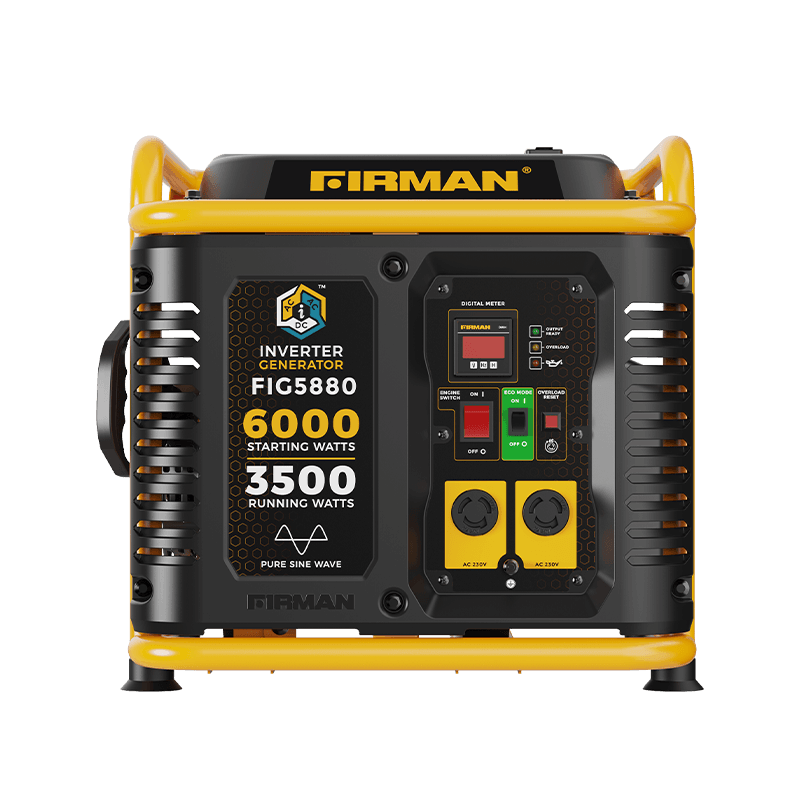
Firman’s FIG5880 shows why conventional generators still have a role alongside inverter technology. This petrol generator provides 6.0 kW of starting power and 3.5 kW of running power. It has a 12 L fuel tank and an alternator using 100% copper-enamelled wire. It supports recoil, and electric starting, with an ECO mode. It gives pure sine wave, THD <3, with which you can plug-in the electronic divices safely.
For logistics planning, the FIG has a gross weight of 29 kg and a packing size of 440 × 540 × 440 mm. Its open-frame design but low noise level, 64 dB(A) @ 7m, while its approximate 18.5-hour runtime at 50% load gives buyers a useful operating reference. These specifications are stated in Firman’s official product information.
Choosing Between Inverter and Conventional Generators
Inverter technology is not automatically the best option for every commercial requirement. Buyers should begin with the electrical loads that need to be powered. Sensitive electronics may make stable inverter output attractive, while conventional units can remain suitable when higher output, straightforward construction, or other project requirements take priority.
Application also matters. A field technician may value compactness and lower noise, while a construction contractor may prioritize output capacity, durability, starting performance, and serviceability. Procurement teams should therefore compare the complete specification rather than selecting equipment based on technology type alone.
What Buyers Should Ask Power Equipment Manufacturers
Business buyers can improve purchasing decisions by requesting clear technical information. Important points include rated and starting output, power-quality characteristics, fuel consumption at specified loads, noise level and test conditions, starting system, fuel capacity, dimensions, weight, protection features, certifications, warranty, and service support.
It is also important to confirm that specifications apply to the exact model and market. Generator configurations can vary by region, and similar model names do not necessarily indicate identical electrical specifications. Clear documentation helps engineering and procurement teams compare products on an equivalent basis.
Why Inverter Technology Is Gaining Ground
The interest in inverter generators portable reflects changing portable-power requirements. Users increasingly need equipment that can work with electronic loads, respond efficiently to variable demand, and fit into mobile workflows. Lower fuel consumption also means the lower cost during running inverter generators. Inverter technology addresses several of these needs through electronic power conversion and generator systems designed for portable applications.
Conventional generators remain relevant where higher output, robust construction, or specific operating requirements are more important than compact inverter architecture. Firman’s portfolio illustrates this distinction by offering both inverter models and conventional generator options for different applications.
Making Portable Power a Better-Fit Investment
The move toward inverter technology is driven by practical requirements: stable power, potentially better fuel efficiency at variable loads, reduced noise, and portability. These advantages explain why more users are considering inverter technology for portable power.
For business buyers, the right choice should depend on the application rather than the trend. Comparing load requirements, runtime, mobility, noise, serviceability, and verified specifications can support a more dependable investment. With both inverter and conventional options, Firman gives buyers a broader basis for matching portable power equipment to actual operating conditions.
