

Exporting medium-voltage electrical equipment involves more than finding overseas buyers. Switchgear must match local voltage standards, installation practices, environmental conditions, certification rules, and project expectations. For exporters, product selection and market preparation need to work together.
A practical export strategy starts with understanding the target market. Voltage levels, grid structures, and technical requirements can differ between countries, while documentation, delivery terms, and after-sales arrangements may also vary by project. These details affect how a supplier prepares products and communicates with engineering companies, utilities, contractors, and industrial customers.
Start With Market-Specific Product Planning
Export plans should begin with the electrical conditions of the destination market. Medium-voltage distribution systems may use different rated voltages, frequency requirements, protection arrangements, and network configurations. A product suitable for one project may need changes before it can be used elsewhere.
Buyers also look at installation space. Urban substations, industrial facilities, renewable energy projects, and distribution network upgrades can have very different site conditions. Compact equipment can be useful where floor space is limited, while modular designs can simplify transportation and site installation.
Environmental conditions also deserve attention. High humidity, dust, temperature changes, altitude, and coastal conditions can affect electrical equipment. Exporters should provide clear information about applicable operating conditions instead of using broad claims about product performance.
Build Compliance Into the Export Process
Technical compliance is closely connected with market access. Before entering a new country, exporters should identify the standards and certification documents required for the intended application. These requirements may involve product construction, insulation performance, temperature rise, testing, documentation, and safety.
Testing records are also important during technical evaluation. Engineering companies and project contractors may request type-test reports, routine-test information, drawings, technical specifications, and installation instructions. Providing these documents in an organized format can reduce repeated technical questions during bidding.
Packaging should receive similar attention. Medium-voltage equipment can contain precision electrical and mechanical components that require protection during transportation. Export packaging should consider vibration, moisture, handling methods, and the length of the shipping route. Clear lifting points and installation markings can also make site work easier.
Use Product Design to Support Overseas Projects
For a medium–voltage switchgear company, product design can influence export efficiency as much as manufacturing capacity. Compact structures can reduce transportation requirements, while modular construction can make equipment easier to integrate into different distribution projects.
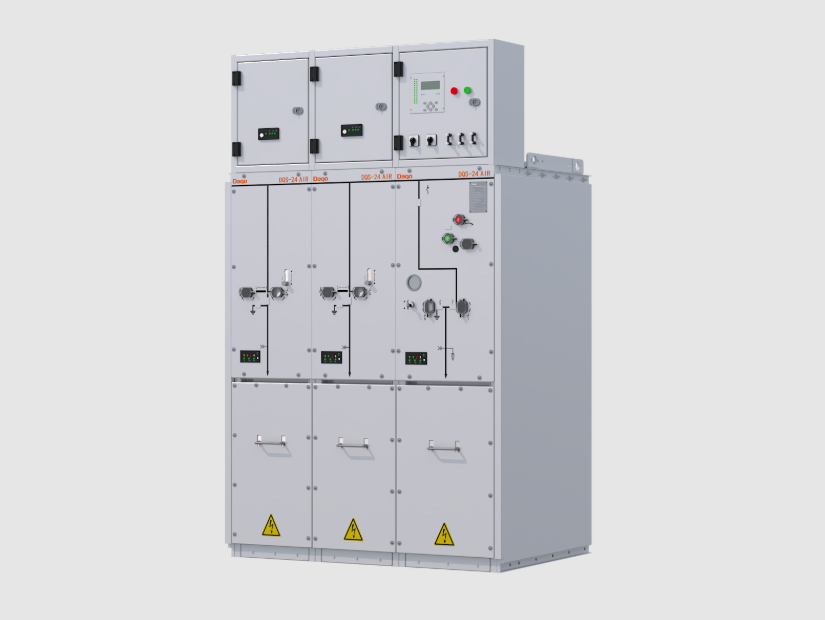
One example is the DQS-24 AIR Eco-Friendly Gas Insulated Ring Main Unit. The DQS AIR series uses clean-air insulation and vacuum interruption. Its design focuses on compact construction, maintenance-free operation, and simplified operation.
The unit provides an alternative to SF₆-insulated and solid-insulated switchgear. Its SF₆-free design also connects product selection with environmental considerations. Such characteristics can be relevant in distribution network upgrades where space, maintenance, and environmental requirements are considered together.
Prepare Technical Documents for International Buyers
International buyers often need more than a product catalogue. They may need dimensional drawings, wiring diagrams, technical parameters, installation instructions, test documents, and maintenance information before approving equipment.
Documentation should use consistent terminology. Rated voltage, rated current, insulation level, enclosure dimensions, and other technical values should be presented clearly. Units should also remain consistent throughout the documents to reduce the risk of misunderstanding between engineering teams.
Product descriptions should match the actual equipment supplied. If a specification changes between product versions, the difference should be stated directly. Accurate documents make technical discussions easier and reduce unnecessary clarification during procurement and installation.
Adapt the Sales Approach to B2B Projects
Export customers in the power sector often work through project-based procurement. Their purchasing decisions can involve engineering departments, procurement teams, contractors, utilities, and system integrators. Product discussions therefore need to address technical and project factors rather than focus only on product features.
For example, buyers may compare equipment according to delivery time, installation method, available technical support, maintenance requirements, and future expansion plans. Price remains relevant, but it is only one part of the purchasing decision.
Daqo Group serves markets that include power distribution and industrial applications. Its product portfolio covers equipment from complete electrical systems to intelligent components. This broader range can be useful when a project requires several related electrical products rather than one isolated unit.
Strengthen Delivery and Project Coordination
Export performance also depends on what happens after an order is confirmed. Production scheduling, factory testing, packaging, shipping documents, and site coordination all affect project progress.
Shorter delivery cycles can be valuable for projects with fixed construction schedules. However, delivery promises should be based on actual production capacity and product configuration. Clear communication is more useful than unrealistic commitments.
Modular equipment can also simplify project implementation. When equipment is designed with practical installation requirements in mind, site teams can spend less time adapting the system during assembly. Technical support during installation can further reduce delays caused by unclear procedures.
Plan for Long-Term Market Development
Entering an overseas market should not be treated as a single sales transaction. After initial projects, suppliers can review recurring technical requests, common site conditions, delivery issues, and customer feedback. These findings can guide future product and service planning.
Environmental requirements may also influence future product selection. SF₆-free technologies, for example, provide one direction for distribution equipment where environmental considerations are becoming part of project evaluation. Buyers may increasingly examine the equipment’s full operating and maintenance profile rather than its initial purchase price alone.
For exporters, long-term market development therefore depends on consistent product quality, practical documentation, responsive communication, and the ability to adjust solutions to different project conditions.
Turning Export Preparation Into Project Value
A successful export strategy combines market research, technical compliance, suitable product design, accurate documentation, and dependable project coordination. These factors help buyers evaluate equipment with fewer uncertainties and make it easier for engineering teams to move from specification to installation.
Daqo Group provides integrated medium-voltage electrical solutions and has developed products such as the DQS AIR series for distribution applications. For overseas projects, this combination of product range, technical development, manufacturing capability, and project-oriented service can provide a practical foundation for cooperation.
