

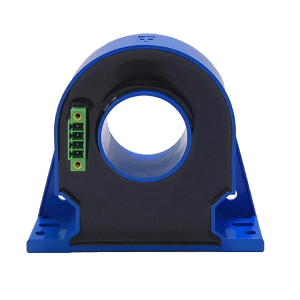
Industrial applications place very different demands on current measurement than basic monitoring circuits. An Industrial-Grade Fluxgate Current Sensor solution needs to maintain reliable measurement across the required current range while controlling offset, drift, linearity, temperature effects, noise, bandwidth, and electrical isolation.
The surrounding application matters just as much: medical equipment, EV mobility, rail systems, and renewable energy installations can expose a sensor to very different waveform, thermal, mechanical, and safety conditions. Hangzhi develops fluxgate measurement technology around multi-point zero-flux control, with precision measurement intended for demanding AC/DC environments.
Accuracy, Linearity, and Long-Term Stability
Precision begins with understanding what the accuracy specification actually represents. A percentage figure may describe performance under a particular temperature, current level, or test condition rather than across the entire operating envelope. Offset error, gain error, linearity, repeatability, and temperature drift should be reviewed separately because each contributes differently to the final measurement uncertainty.
Linearity becomes particularly significant in systems that operate across a wide dynamic range. A sensor may measure nominal current accurately while showing a different error profile close to zero or near its upper range. Fluxgate architectures use closed-loop magnetic compensation to keep core flux near zero, supporting accurate measurement of AC, DC, pulsed, and more complex waveforms. Commercial fluxgate designs also emphasize low residual noise, temperature stability, and low offset drift.
Long-term stability adds another dimension. Industrial equipment may remain operational for years, making a small offset change over temperature or time more meaningful than an impressive initial laboratory value. A sound evaluation should examine ppm-level drift, thermal coefficients, repeatability after power cycling, and behavior following overload events. Fluxgate Current Sensors are particularly relevant where accumulated measurement error could affect calibration, energy analysis, or closed-loop control.
Bandwidth and Dynamic Measurement in Industrial-Grade Fluxgate Current Sensor Selection
Bandwidth should correspond to the waveform that actually needs to be measured. A slow DC process, a motor drive, and a high-frequency power converter do not require the same frequency response. Insufficient bandwidth can suppress useful transient information, while excessive bandwidth may expose the measurement chain to switching noise that has little value to the application.
Response time provides another useful metric. It describes how quickly the sensor output follows a current change, whereas bandwidth characterizes frequency response. Both matter in systems containing rapid load changes, converter switching events, or short-duration transients. Hangzhi’s AIT Series offers response times of 1 μs with bandwidth options reaching 800 kHz. The exact balance depends on the sensing architecture and operating range.
Noise deserves attention alongside speed. A wider measurement window is not automatically beneficial if high-frequency interference overwhelms a small signal of interest. Filtering, shielding, grounding, sensor placement, and output-interface design should be assessed as part of the complete measurement path rather than treating the transducer as an isolated component. Industrial-grade fluxgate current sensors require bandwidth and dynamic measurement to be evaluated against the actual waveform, noise environment, and operating conditions.
Isolation and Application-Specific Requirements
Galvanic isolation is often essential when current flows through a high-voltage power stage. Magnetic sensing allows the measurement circuit to remain electrically separated from the primary conductor, reducing the need to place sensitive electronics directly at the same electrical potential. The required isolation rating, insulation distance, transient withstand capability, and installation environment still need individual verification.
Different industries introduce different priorities. Medical systems may emphasize exceptionally stable current measurement in imaging or power-supply equipment. EV platforms can require accurate readings across battery, inverter, charging, and drive systems. Rail applications introduce demanding temperature and environmental conditions, while renewable-energy converters may combine DC currents with switching components and grid-side AC waveforms. Hangzhi identifies medical equipment, EV mobility, rail systems, and renewable energy among the application areas for its fluxgate current measurement technology.
The About Hangzhi information provides additional background on the company’s precision measurement technology and application scope. Its multi-point zero-flux approach is intended to maintain controlled magnetic conditions during measurement, which is relevant to systems where low drift and stable accuracy matter more than basic current detection. Such architecture-level information can be useful when comparing sensors that may appear similar from their headline current ratings alone.
Selecting the Right Industrial Configuration
Current range should reflect both normal operation and foreseeable transient conditions. A sensor rated only around the nominal operating point may leave insufficient margin during acceleration, regenerative events, startup, or fault conditions. Conversely, excessive range can reduce the practical resolution available for small currents, so the useful measurement window should be considered rather than simply selecting the largest rating.
Mechanical integration can also affect measurement quality. Busbar position, conductor geometry, nearby magnetic materials, cable routing, enclosure construction, and spacing between phases may influence magnetic-field distribution. Laboratory specifications are most meaningful when the final installation reproduces the conditions under which the sensor will operate.
Conclusion
A suitable current sensor is ultimately defined by the measurement problem it must solve, not by a single headline specification. Accuracy matters, yet its value depends on linearity, drift, temperature behavior, noise, bandwidth, isolation, installation conditions, and the waveform being measured. Industrial-Grade Fluxgate Current Sensors can be particularly appropriate when stable AC/DC measurement is required across demanding operating environments.
The technology also fits applications in which small offsets or long-term drift could influence system-level results. Hangzhi focuses on high-precision current and voltage measurement using multi-point zero-flux technology, while the About Hangzhi page offers further technical and application background. Teams with application-specific questions can contact us to discuss the relevant measurement conditions and specifications.
