

Choosing suitable lighting for a production line requires more than comparing brightness, energy consumption, or fixture prices. Manufacturers must consider visual accuracy, worker comfort, installation conditions, maintenance access, and the flexibility to accommodate changing production layouts. For businesses planning an industrial lighting upgrade, the right solution should support daily operations while controlling long-term costs. TRIECO specializes in integrated lighting retrofit solutions, including modular trunking systems designed for structured manufacturing environments.
Assess the Lighting Requirements of Each Production Task
Different production activities demand different lighting conditions. General assembly may require consistent illumination across workbenches, while quality inspection, precision testing, and detailed component handling may need higher illuminance and better visual clarity. Warehouses and circulation routes have different requirements again.
Before selecting equipment, manufacturers should map their production processes and identify critical visual tasks. Lighting designers can then determine appropriate illuminance levels, uniformity, glare control, and color rendering requirements. Applicable standards and local regulations should guide these decisions rather than let a single brightness target for the entire facility dictate them.
Evaluate Light Distribution and Uniformity
Uneven lighting can create shadows, dark spots, and distracting contrasts between workstations. These problems may make it harder for operators to identify defects, read labels, or handle small components accurately. A well-planned layout distributes light across production benches, machinery, inspection points, and access routes.
Linear lighting is particularly useful where workstations follow continuous production lines. Properly arranged fixtures can create consistent illumination along the working area while reducing visual interruptions between individual luminaires. However, the final result depends on mounting height, fixture spacing, beam distribution, ceiling conditions, and the reflectance of surrounding surfaces. A photometric layout should therefore be reviewed before installation.
Choose a Modular LED Light Trunking System
For factories with long production lines, modular lighting can simplify installation and future adjustments. An LED light trunking system typically uses a continuous mounting and electrical infrastructure that accommodates compatible lighting modules along a defined route. This approach can reduce the need to install separate luminaires and wiring arrangements at every position, depending on the system design.
Modularity is especially useful when assembly stations move, production capacity expands, or equipment layouts change. Facility managers should check module compatibility, connection arrangements, mounting options, and the availability of replacement components before purchasing. They should also confirm that the proposed system suits the building’s electrical infrastructure and installation conditions.
Compare Energy Efficiency and Total Operating Costs
LED technology can reduce electricity consumption compared with older lighting technologies, but purchase price alone does not determine value. Buyers should compare system wattage, expected operating hours, light output, energy tariffs, maintenance requirements, and the cost of installation.
A practical assessment should also consider maintained light output over time, driver reliability, warranty coverage, and component replacement costs. An inexpensive fixture may offer limited value if it requires frequent servicing or delivers inadequate illumination. Conversely, a well-designed retrofit can improve lighting quality while reducing energy and maintenance expenses over the system’s service life.
When evaluating LED factory lights, procurement teams should request documented performance data and calculate projected savings against the existing installation. Occupancy sensors or daylight-responsive controls may provide additional savings where operating patterns and site conditions make them appropriate.
Check Environmental Suitability and Maintenance Access
Production facilities can expose lighting equipment to dust, moisture, vibration, heat, or airborne contaminants. Buyers should assess these conditions before selecting fixtures, checking ingress protection ratings, operating temperature ranges, material suitability, and any relevant electrical safety certifications.
Maintenance access deserves equal attention. Lighting installed above machinery or busy production lines may require specialist access equipment and production interruptions for servicing. A modular LED light trunking arrangement can help simplify component replacement when the system supports independent module changes and accessible connections. However, actual maintenance requirements depend on the specific product design and installation.
Factories should also establish a cleaning and inspection schedule. Dust accumulation and component ageing can reduce lighting performance, so initial design calculations should account for expected operating conditions and maintenance practices. Relevant workplace lighting standards, including ISO/CIE 8995-1:2025, provide guidance on illuminance, glare, color rendering, and other factors affecting indoor visual conditions.
Review Real-World Applications Before Making a Decision
Project references can help facility managers understand how a lighting system performs within an actual manufacturing environment. A useful case study should explain the production setting, lighting arrangement, installation constraints, and operational objectives rather than relying exclusively on promotional claims.
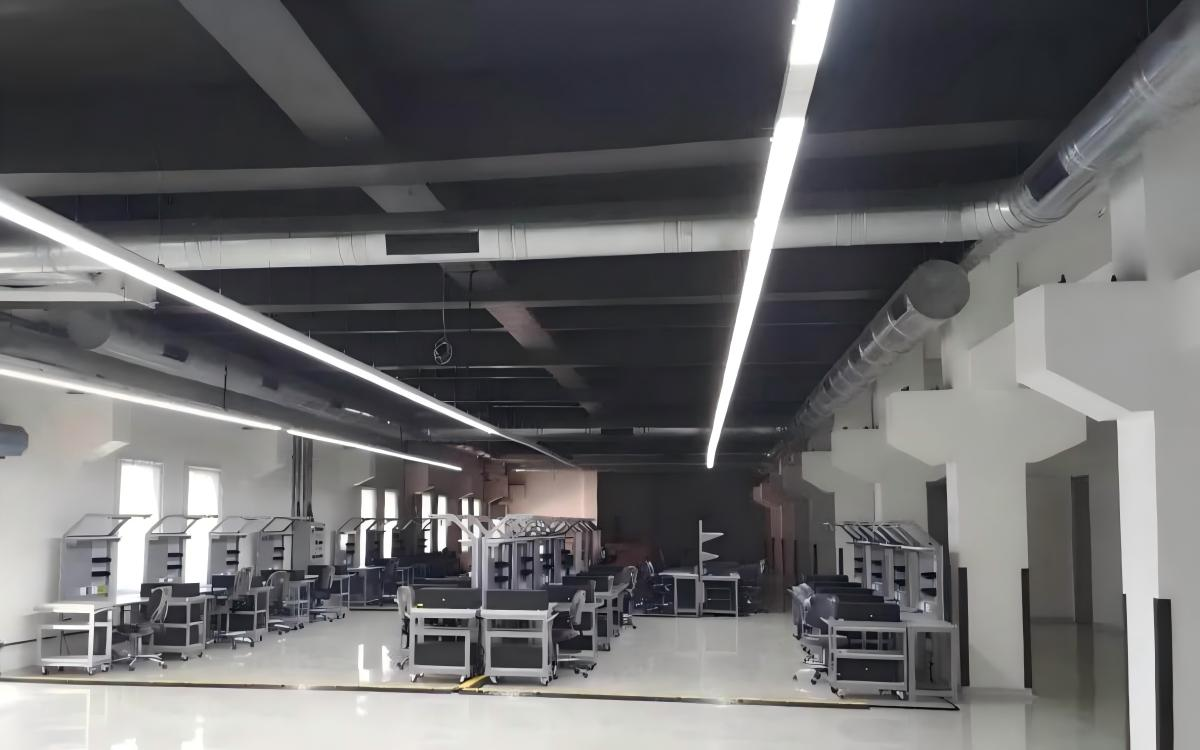
At Focus Lighting And Fixtures Limited’s factory in India, TRIECO’s trunking light system uses continuous linear runs above assembly, testing, and production areas. The arrangement creates a structured lighting layout across workbenches, equipment, and circulation zones while helping reduce visual clutter from separate luminaires and wiring. Its modular architecture also supports adjustments as workstation layouts evolve.
For procurement teams, this application illustrates why LED factory lights should be assessed as part of an integrated installation rather than as isolated products. Comparing project requirements with documented system capabilities can help buyers identify a suitable solution for their own facility.
Make the Right Choice for Long-Term Production Needs
Selecting industrial lighting requires balancing visual performance, energy efficiency, safety, installation complexity, and future flexibility. Manufacturers should begin with task-based lighting requirements, verify distribution through a lighting design, and compare lifecycle costs alongside product specifications.
For facilities considering a retrofit, LED light trunking may offer a practical approach to continuous production-line illumination and adaptable workstation layouts. TRIECO‘s integrated retrofit solutions provide a relevant option for manufacturers evaluating modular lighting arrangements. By combining a clear assessment of operational needs with verified technical data and a realistic maintenance plan, businesses can make more informed investment decisions and build a lighting system suited to their production goals.
