

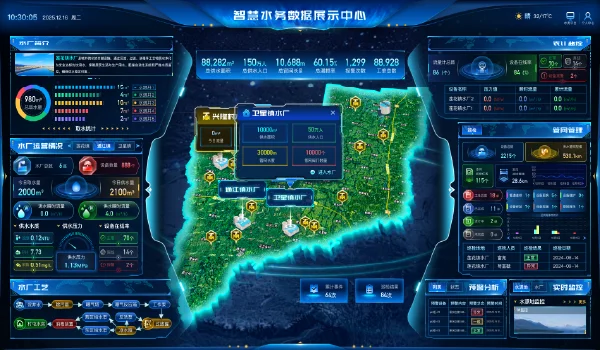
Water systems are becoming increasingly complex as cities and industries face challenges such as aging infrastructure, rising operational costs, and stricter environmental regulations. Traditional water management methods often rely on periodic inspections and fragmented data, making it difficult to identify risks and optimize resource allocation in real time. Modern solutions combining sensors, digital platforms, and artificial intelligence are transforming how organizations monitor and manage water resources.
An advanced intelligent water management system enables operators to collect real-time information, analyze changing conditions, and make data-driven decisions across the entire water lifecycle. By integrating IoT technologies, digital twins, and 3D visualization, smart water platforms provide a more efficient approach to improving reliability, sustainability, and operational performance.
The Growing Role of Real-Time Water Monitoring Technologies
Water quality monitoring has traditionally depended on manual sampling and laboratory testing, which can delay responses to contamination risks or system failures. Real-time monitoring technologies address these limitations by using connected sensors to continuously measure critical parameters, including temperature, turbidity, chemical levels, and other indicators.
For municipal water providers, industrial facilities, and environmental management organizations, continuous data collection creates greater visibility into system performance. Operators can detect abnormal conditions earlier, reduce response times, and improve compliance with water safety requirements.
The combination of sensors with cloud-based platforms also allows different departments to access updated information simultaneously. This improves coordination between operation teams, maintenance personnel, and decision-makers while supporting more proactive management strategies.
How IoT Water Management Improves Operational Efficiency
The development of IoT water management solutions has introduced a new level of connectivity to modern water infrastructure. Internet of Things technology enables sensors, equipment, and monitoring platforms to communicate continuously, creating a unified digital environment for water operations.
Connected systems can track equipment conditions, monitor consumption patterns, and identify potential failures before they become major problems. This predictive capability helps organizations improve maintenance planning and reduce the risk of unexpected downtime.
For large-scale water networks, IoT-based solutions provide valuable insights into distribution efficiency, leakage detection, and resource utilization. By combining real-time data with intelligent analytics, operators can optimize water allocation and improve overall system performance.
Digital Twin Technology Creates a Smarter Water Management Environment
Digital twin technology is becoming an important component of modern water management platforms. A digital twin creates a virtual representation of physical water infrastructure, allowing organizations to visualize assets, monitor conditions, and simulate possible scenarios.
The platform applies spatial intelligence, 3D technology, and AI capabilities to develop digital twin-powered smart water management solutions. Its platform enables synchronization between physical water infrastructure and digital models, helping users achieve real-time monitoring and more precise control.
Through immersive 3D visualization, operators can better understand complex water networks, treatment facilities, and equipment conditions. This improves daily operations while supporting emergency planning through simulation and scenario analysis.
AI-Driven Analysis Supports Smarter Water Infrastructure Decisions
Collecting large amounts of water data is only valuable when organizations can transform information into actionable insights. Artificial intelligence provides advanced analytical capabilities that help identify patterns, predict risks, and recommend optimized solutions.
An Iot water management system combines IoT monitoring, big data analysis, and simulation technologies to improve decision-making. Instead of relying only on historical records, operators can use real-time information to anticipate potential problems and adjust operations accordingly.
For example, AI analysis can support equipment maintenance planning, water demand forecasting, and emergency response preparation. These capabilities allow organizations to move from reactive management toward a more predictive and efficient operational model.
Supporting Compliance Through Integrated Water Monitoring Platforms
Regulatory compliance is a major consideration for organizations managing water resources. Governments and industry authorities continue to introduce stricter requirements related to water quality, environmental protection, and operational transparency.
Integrated monitoring platforms help organizations maintain accurate records and demonstrate compliance through continuous data collection. Real-time reporting capabilities make it easier to track key performance indicators and identify areas requiring improvement.
A comprehensive digital water solution can also integrate safety management, asset control, emergency drills, and lifecycle management functions. This creates a centralized environment where organizations can manage infrastructure more effectively while improving accountability.
Building Scalable Smart Water Solutions for Future Needs
As cities and industries continue to expand, water management systems must be flexible enough to support changing requirements. Scalable architectures allow organizations to add new monitoring points, integrate additional data sources, and adapt solutions for different application scenarios.
Icecypress Technology focuses on creating reusable and customizable smart water management architectures supported by digital assets and standardized components. Its solutions combine drone photogrammetry, low-altitude data, 3D modeling, and AI to provide comprehensive geospatial intelligence capabilities.
This approach helps organizations build a stronger digital foundation for future water infrastructure development. By connecting physical systems with intelligent platforms, businesses and governments can achieve better resource management and long-term operational improvements.
The Future of Intelligent Water Infrastructure Management
Real-time water quality monitoring is evolving beyond simple sensor deployment. The integration of IoT connectivity, digital twins, artificial intelligence, and spatial intelligence is creating a new generation of water management solutions that deliver deeper visibility and smarter decision-making.
With its expertise in 3D and AI technologies, Icecypress Technology supports organizations seeking advanced digital water solutions. Its digital twin-powered platforms support real-time data integration, 3D visualization, and intelligent analysis, helping customers improve operational visibility and support infrastructure management.
